
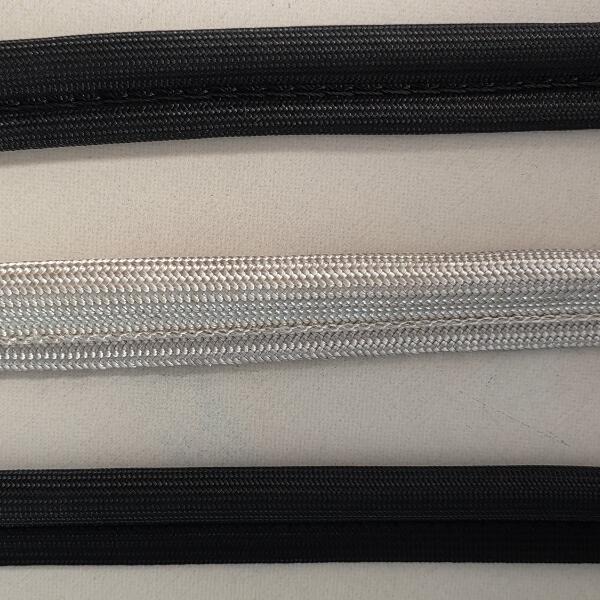
The double-bulb tadpole gasket has an intertwined fiberglass-yarn outer surface around two adjacent cores. The paired bulbs and connecting tail form one shaped textile profile. For a heated-equipment closure, this gives the designer a specific cross-section to compare with the mating surfaces rather than treating the gasket as an ordinary round cord.
Model TD-DB-WC-CO-BC-D12-D5-L6-T2 has bulb diameters of 12 mm and 5 mm, a tail length of 6 mm and a thickness field of 2 mm. These dimensions identify the captured model. Use the complete profile and its orientation when reviewing the available landing and closing movement.
Two supported bulbs form one profile
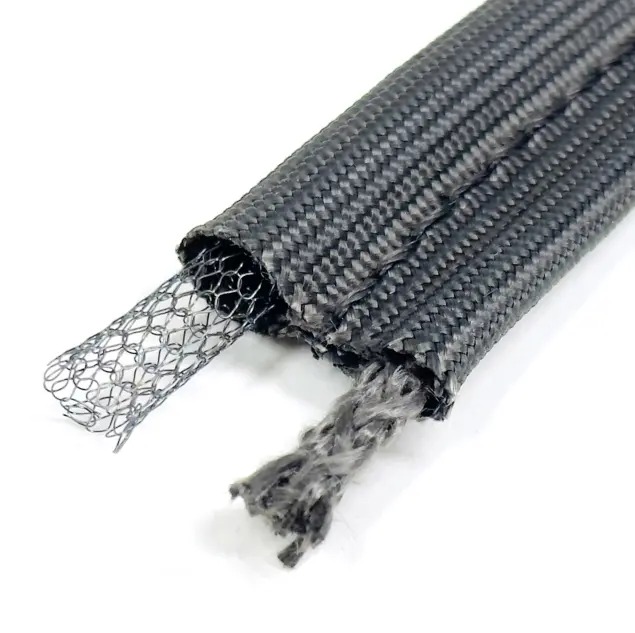
The double-bulb tadpole gasket uses a stainless-steel-wire supporting tube in one core and a braided cord in the other. The two different internal supports are part of the product construction. An end view makes that distinction visible and helps the engineer keep the two bulb positions identified on a drawing.
This is useful when a mating arrangement has different space or contact conditions across its cross-section. The two bulbs can be considered as parts of one candidate profile, with the outer textile and internal support retained in the same orientation. Their presence does not establish a universal spring force, compression percentage or sealing result.
Read the unequal bulb and tail dimensions together
| Model dimension | Value | Review purpose |
|---|---|---|
| First bulb diameter | 12 mm | Identify the larger bulb in the cross-section |
| Second bulb diameter | 5 mm | Identify the smaller bulb in the cross-section |
| Tail length | 6 mm | Retain the tail when checking the profile footprint |
| Thickness | 2 mm | Retain this labelled model dimension for drawing clarification |
Product and Specification Reference: TD-DB-WC-CO-BC-D12-D5-L6-T2 double-bulb tadpole gasket; Bonsing public product-detail information reviewed in October 2026. The dimensions apply to this captured model. Confirm their drawing definitions and the requested profile during technical review; they are not compression or installation settings.
A single outside measurement cannot describe the whole paired-bulb form. Keeping the two diameters and tail together helps prevent a replacement enquiry from collapsing the profile into a round gasket of roughly similar size. It also gives the supplier a precise starting point when a customised size is being discussed.
Match the profile orientation to the mating surfaces
Place the complete cross-section beside the mating profile on the assembly drawing. Identify which side carries each bulb, where the tail lies and what surface moves during closure. This makes the contact question reviewable before a long length of gasket is selected.
Compare the open and closed positions using the equipment designer’s intended closure travel. A profile that occupies the available space in the open view may still meet the moving surface differently as the closure approaches its final position. The useful assessment therefore follows the mating relationship, rather than only the nominal gap.
If the larger and smaller bulbs are reversed, retain that as a distinct candidate orientation. Do not assume that reversing a non-symmetrical profile leaves the contact arrangement unchanged. Where the geometry does not match, discuss a customised profile with the mating drawing and the required contact region.
Separate locating adhesive from sealing contact
Self-adhesive tape is available as an installation option for this double-bulb gasket. That allows adhesive-assisted positioning to be discussed as a mounting choice, rather than treating it as a component included in every supplied gasket.
The locating method and the closure-contact task remain separate design questions. Specify the frame surface and mounting requirement, then review the adhesive option for those conditions. The fact that the gasket can be positioned on a frame does not determine its contact with the closing surface or prove the assembled seal’s leakage performance.
Evaluate the closure on representative geometry
Use a representative mating section to evaluate orientation, available landing, closure travel and contact. Retain the exact gasket model and candidate mounting arrangement with the observations. Agree the equipment’s acceptance criteria before interpreting the result.
A changed frame section or contact requirement calls for a targeted profile discussion. Provide the changed geometry and consider a customised configuration rather than assigning a compression allowance to the published model dimensions.
FAQ
Are both bulbs supported by the same core material?
No. This double-bulb construction uses a stainless-steel-wire supporting tube in one core and a braided cord in the other.
Does the 2 mm thickness field define gasket compression?
No. It is a labelled dimension of the captured model. Confirm its drawing definition and evaluate the required closing contact separately.
Is self-adhesive tape included in every gasket?
It is an available installation option. Specify the mounting requirement and confirm the requested configuration rather than assuming it is included.
Request a Double-Bulb Profile Review
Use the double-bulb tadpole gasket model as the starting reference. Send the mating cross-section, proposed orientation, available landing, closure travel, target contact and mounting method. Request a double-bulb profile review with Bonsing to discuss that model or a customised profile.
Post time: Nov-04-2026