
When the pipe itself is hot, insulation selection starts at that source rather than at a separate hose nearby. Pyroflex silicone-coated fiberglass firesleeve is a thick-walled woven glass-fiber sleeve coated with flame-retardant silicone rubber. A sleeve around the hot pipe introduces a textile wall between that pipe and its surroundings.
Pyroflex firesleeve has a stated continuous high-temperature resistance of 260°C. For a hot-pipe application, the useful first question is whether the proposed covering suits the pipe’s actual surface duty. The next question is what happens on the receiving side: an adjacent cable, a neighbouring component or another defined location in the equipment.
Put the heat source inside the covering
Protecting a hose from an external hot surface and covering the hot surface itself involve different arrangements. In the first, the sleeve surrounds the line receiving heat. In the second, the sleeve surrounds the pipe from which heat is leaving.
That distinction changes where the engineer looks for exposed sections and where a comparison is measured. A short sleeve on a nearby cable cannot be treated as equivalent to a covering around the source pipe. Start by drawing the pipe, the proposed covered length and the objects affected by its heat.
Pyroflex firesleeve can also be considered for heat passing from a hot pipeline toward its surroundings. Its value in this arrangement is the intervening covering at the source. The amount of heat reaching a particular object still depends on the complete layout, not only on the sleeve material.
A coated glass-fiber wall around the pipe
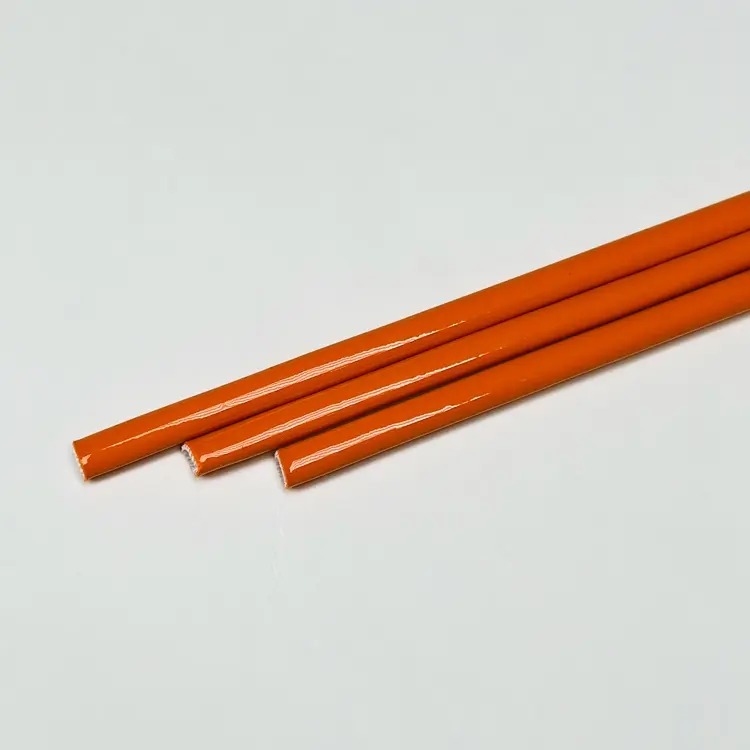
The glass-fiber body and silicone outer layer form the covering around the hot line. Seeing the sleeve as a wall helps keep the product decision concrete: which section of pipe is inside it, where the wall begins and ends, and which nearby surface is being considered?
This source-side approach is worth evaluating when a defined pipe segment contributes heat to a crowded equipment area. It connects the material choice to a particular heat path. The receiving component can then be assessed in relation to the covered section rather than to an unspecified “high-temperature zone.”
The sleeve is supplied as a tubular product. A separate design decision is how it can be fitted to the intended pipe segment, especially where joints or changes in geometry interrupt that segment. Define that arrangement before treating the covered length as continuous insulation.
Follow the heat around the sleeve ends
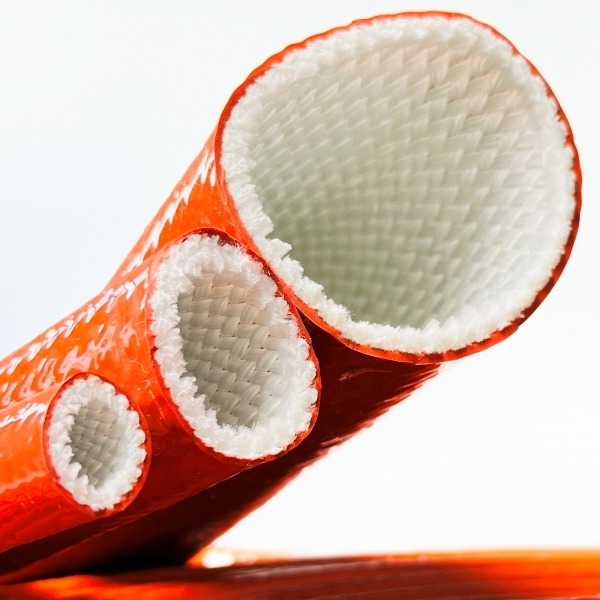
The edge of a covering is an important change in the arrangement. A nearby object may face the covered pipe at one position and an uncovered joint a little farther along. Extending a temperature measurement from the first location to the second would conceal that difference.
Mark exposed joints, supports and covering ends on the layout. Also distinguish an adjacent object with a clear space from one touching another part of the pipe assembly. These paths deserve separate consideration because the sleeve covers only the section physically inside it.
The cross-section is useful here. A tubular wall has an inside, an outside and open ends; it is not a sealed enclosure around the whole piping system. This makes the coverage boundary a visible design feature, rather than an assumption hidden inside a product name.
Define the receiving side before comparing results
“Reduce heat around the pipe” is too broad to make a useful acceptance condition. Name the receiving location and the operating state that matter to the equipment design.
| Design question | Useful comparison input |
|---|---|
| A nearby cable is exposed to heat from the pipe | Cable position, separation and the relevant cable temperature limit |
| A neighbouring component sits beside a covered segment | Component location and comparable equipment operating conditions |
| The sleeve’s outer surface matters to the design | Surface measurement location, duty and the applicable acceptance requirement |
| Exposed ends may dominate a local result | End positions and receiving points near those ends |
The product’s continuous resistance figure describes the sleeve’s thermal scope; it is not a prediction of outer-surface temperature. Do not use it to designate a touch-safe surface. Likewise, an outer-surface reading alone does not establish an energy-saving percentage for the equipment.
A focused assembly evaluation
Compare a representative covered arrangement under a defined operating duty. If a baseline comparison is needed, keep pipe conditions, receiving location and measurement method comparable. Record coverage limits so that a result from the centre of the sleeve is not silently applied to an exposed end.
This gives the engineer a practical decision: whether the proposed covering and layout address the receiving-side requirement. If the duty, pipe geometry or coverage arrangement differs, discuss a customised configuration with those changes and the required acceptance point. The next step is a targeted technical discussion, rather than a promised temperature drop.
FAQ
Is covering a hot pipe the same as protecting a nearby hose?
No. Covering the hot pipe places the sleeve at the heat source. Covering the nearby hose places it around the line receiving heat. Evaluate the intended arrangement and its exposed sections.
Does the 260°C figure define the sleeve’s outer-surface temperature?
No. It is the stated continuous high-temperature resistance of Pyroflex. Outer-surface temperature depends on the covered assembly and operating conditions.
Can a sleeved hot pipe be assumed safe to touch?
No. Assess the relevant surface under the actual duty and applicable contact-temperature requirements before making that decision.
Discuss a Hot-Pipe Insulation Configuration
Provide the pipe geometry, surface-temperature/time profile, proposed covering limits, nearby components and distances, and the receiving-side acceptance criteria. Discuss a hot-pipe insulation configuration with Bonsing using the Pyroflex firesleeve as the starting point for a configuration or tailored-solution review.
Post time: Oct-20-2026