
A firesleeve on a moving hydraulic hose should be evaluated through the hose’s complete travel, rather than only in its parked position. Pyroflex silicone-coated fiberglass firesleeve is a thick-walled woven glass-fiber sleeve coated with flame-retardant silicone rubber. It provides the surrounding thermal covering; the hose, its fittings and the machine determine the working route.
Pyroflex firesleeve is installed on cables and hoses and can expand over fittings or joints. Passing the sleeve onto the assembly is one task. Keeping that covering in a useful position as the hose bends and moves is another. Begin with the hose manufacturer’s routing requirements, then examine the covered assembly in each operating position.
Start with the covered hose
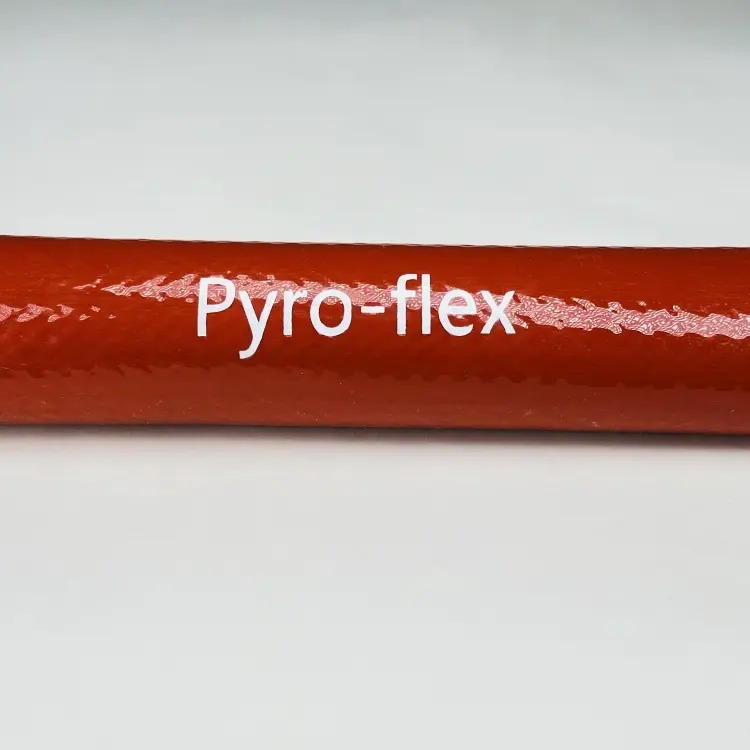
An uncovered hose outline is an incomplete representation of the final route. The covering adds an outer wall around the line, so the space available beside a bracket, neighbouring hose or machine surface needs to be assessed with the sleeve in place.
This is where a tubular covering is useful: it follows the line being protected instead of requiring the buyer to treat the hose and its outer thermal layer as unrelated items. A representative assembly lets the designer see the line, covering and adjacent objects together. It also makes the intended protected length visible to the team reviewing the machine layout.
Use the actual hose and a candidate sleeve for the route trial. A sketch of a bare hose cannot show how the sleeve end, the bend and a nearby support occupy the same space.
Follow the moving bend
A hose that looks comfortably curved at rest may take a different shape at the opposite end of travel. Examine the intermediate positions as well as the two endpoints. Look for the location where the bend tightens, where the covered line approaches an obstruction and where the sleeve gathers or changes position.
The sleeve’s ability to pass over a fitting helps with installation access. It does not establish the hose’s minimum bend radius. Apply the hose manufacturer’s bend requirement to the hose and assess how the additional covering behaves around that route.
For example, a moving loop can bring the outside of the covered bend close to a frame edge while its straight section still appears clear. Following the loop through travel exposes that local relationship. The useful decision is whether the chosen route and covering remain workable together, rather than whether the loose sleeve bends easily on a bench.
Keep sleeve ends within the working route
The sleeve end is a transition between the covered and uncovered portions of the assembly. Decide where that transition belongs relative to fittings, supports and the moving section. Then observe whether the end stays in the intended position during travel.
A protected length that works in one position may leave a different segment exposed in another if the covering moves along the line. Conversely, extra material can gather where the route offers little room. These observations help the buyer discuss the required length and end arrangement with the assembly designer.
Treat any proposed end restraint as a separate assembly detail. Its location and attachment method should suit the hose and machine design. The firesleeve itself is the covering; it should not be assigned the job of a hose support or motion-control component.
The coating and glass-fiber body have different roles
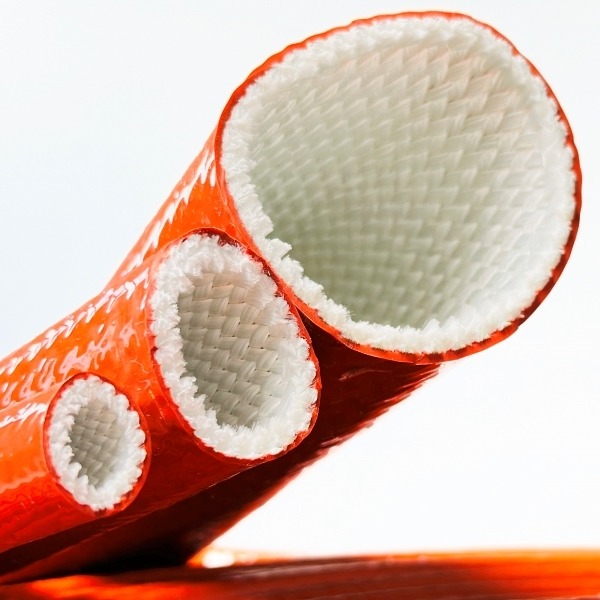
The silicone-coated exterior and the woven glass-fiber interior form the wall around the hose. The exposed cutaway makes that layered construction easier to understand than a photograph of the outer surface alone.
For a moving route, the practical value is being able to evaluate a thermal covering directly around the line that changes position. That keeps the material choice connected to the route, instead of selecting a thermal product first and discovering its installation constraints later.
Pyroflex firesleeve has a stated continuous high-temperature resistance of 260°C. Use that product figure as part of thermal selection alongside the mechanical route trial. It does not give the temperature reached by the enclosed hydraulic hose, and a successful cold movement check is not a thermal evaluation.
Evaluate the complete motion envelope
Keep the trial focused on observations that change the design:
- Fit the candidate covering to a representative hose assembly using the intended sequence.
- Move the assembly through its normal travel under the buyer’s safe test procedure.
- Record tight bends, contact locations, changes in covered length and sleeve-end movement.
- Review those observations against the hose routing limits and the required thermal duty.
If the available route or covering arrangement needs to change, discuss a customised configuration with the line drawing, movement positions and exposure profile. The review should address the changed condition directly, rather than choosing a larger sleeve by assumption.
FAQ
Does firesleeve define the hydraulic hose’s minimum bend radius?
No. Use the hose manufacturer’s bend requirement, then evaluate the covered assembly through its movement.
Is a static fit check enough for a moving hose?
A static check establishes only one position. Examine the complete travel for changes in bends, contact, covered length and sleeve-end position.
Can a cold movement trial confirm thermal protection?
No. It helps assess the route and covering behaviour. Thermal selection and assembly evaluation need the actual exposure conditions and component limits.
Request a Moving-Hose Route Review
Send Bonsing the hose drawing, operating positions, applicable bend limits, covered length, end and support locations, and temperature/time profile. Request a moving-hose route review to discuss the Pyroflex firesleeve configuration or a tailored covering arrangement for the proposed route.
Post time: Oct-19-2026