
GLASFLEX UT is a braided sleeve made with continuous fiberglass filaments. It forms a flexible surrounding textile layer for a thermal covering task, giving the buyer a glass-fiber construction to evaluate around a hose rather than a rigid shell that dictates the route.
GLASFLEX UT has a continuous temperature capability up to 550°C. GLASFLEX UT is flexible and expandable and is used around rubber hoses. The useful starting point is therefore the covered hose assembly: its route, exposed segment and end transitions, together with the hose’s own operating conditions.
A continuous-filament glass-fiber covering
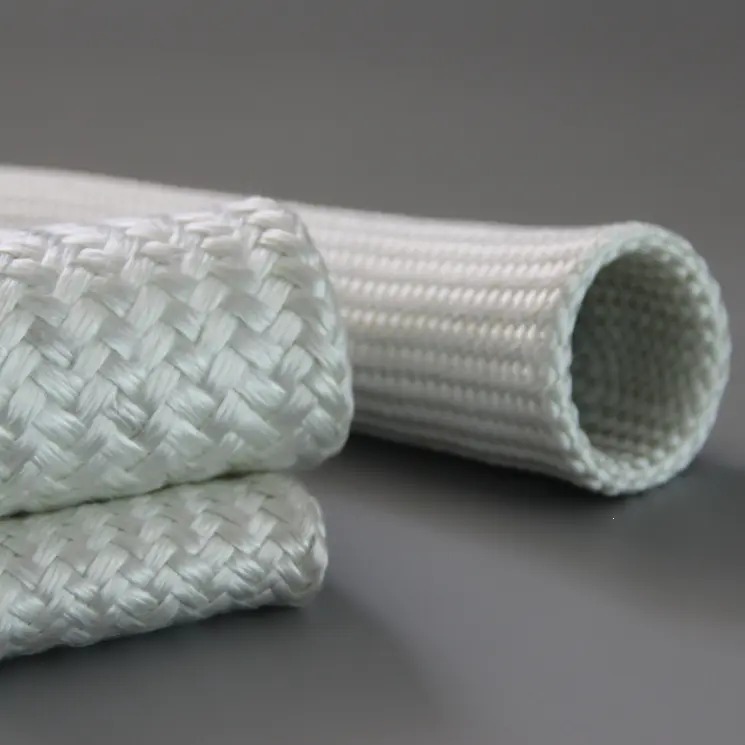
The intertwined continuous glass filaments form the sleeve wall and the hollow passage through it. This provides a defined surrounding covering whose construction can be recognised at the surface and open end. The braid is the product being selected; the rubber hose and its fittings remain parts of the buyer’s assembly.
GLASFLEX UT provides a covering for pipes, hoses and cables against molten splashes. Where such exposure is part of the duty, identify the affected segment and the direction from which it occurs. This gives the covering a concrete task without assuming that every neighbouring component has the same acceptance requirement.
Flexibility matters along the rubber-hose route
A hose often follows a route rather than a straight line. A flexible, expandable sleeve can be evaluated along that shape, allowing the team to assess the surrounding covering where the hose bends and changes direction. This is a practical reason to consider the textile construction early in hose design.
Compare the sleeve at a straight section and at the required bend. Check whether it can remain in the intended position and whether nearby supports leave room for the covered assembly. Retain the hose manufacturer’s bend limits; the sleeve’s flexibility does not define a new permitted bend radius for the hose.
An isolated open-end view helps identify the wall. A view on an actual hose/fitting relationship answers a different question about where the covering ends. Use both forms of information in the review rather than expecting a loose product photograph to settle the whole installation.
Treat the sleeve and hose temperature limits separately
The 550°C continuous capability concerns the GLASFLEX UT sleeve. The rubber hose, conveyed medium and fittings have their own operating limits. Keep those limits alongside the covering requirement so that the engineer is evaluating an assembly rather than assigning the textile figure to every enclosed part.
| Product detail | Scope for initial selection |
|---|---|
| Continuous fiberglass-filament braid | GLASFLEX UT sleeve construction |
| Continuous temperature capability up to 550°C | Sleeve capability; not a guaranteed inner-hose temperature |
| Size range 13–100 mm | Product range for a configuration discussion |
| Flexible and expandable construction | Basis for evaluating a surrounding layer along a rubber-hose route |
GLASFLEX UT has a size range of 13 mm to 100 mm.
Product and Specification Reference: GLASFLEX UT braided sleeve; public Bonsing product-detail information reviewed in October 2026. These construction, temperature and size statements apply to the UT product on that page. Confirm the requested configuration and assembly conditions during technical review.
For an assembly acceptance question, define the exposure and the hose’s allowable condition, then determine the evaluation needed. A sleeve capability figure alone does not calculate the temperature inside a covered hose.
Check the transition from covered hose to fitting
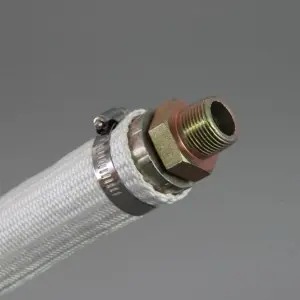
The end of the sleeve is a visible boundary in the covering. Review where it sits relative to the fitting, nearby support and segment requiring protection. A photograph of a covered hose end can make this relationship clearer than a product dimension by itself.
The example relationship is useful for recognising the transition, not for prescribing a particular clamp, termination method or fitting compatibility. Define the intended end arrangement through the assembly drawing and applicable hose procedures. Assess the uncovered transition according to the actual exposure instead of assuming the sleeve protects beyond its end.
Choose an assembly for review within the size range
Start with one representative hose and the covered length, route and fitting geometry. These inputs let the review connect the product’s flexible form to a specific task. Evaluate the surrounding covering without treating the range endpoints as a sizing rule.
If the route, thermal duty or end arrangement needs a different solution, discuss a customised configuration with the drawing and the changed condition. Keep the sleeve selection connected to the hose and exposure requirements throughout that discussion.
FAQ
Does 550°C become the rubber hose operating temperature?
No. It is the continuous capability of the GLASFLEX UT sleeve. Review the hose, medium and fittings against their own limits and evaluate the covered assembly under the intended exposure.
Is GLASFLEX UT the same construction as silicone-coated firesleeve?
GLASFLEX UT is a continuous-filament fiberglass braided sleeve. Pyroflex uses a woven glass-fiber sleeve with a silicone-rubber coating. Keep the construction and specifications tied to the selected product.
Does sleeve flexibility set the hose bend radius?
No. Follow the hose’s own bend requirements and evaluate the sleeve along that permitted route. Sleeve flexibility supports the covering task without changing the hose specification.
Discuss a GLASFLEX UT Hose Covering
Review the GLASFLEX braided sleeve details. Send Bonsing the rubber-hose dimensions, covered length, route and bends, fitting transition, thermal exposure and assembly acceptance needs. Discuss a GLASFLEX UT hose covering or a customised configuration for the required arrangement.
Post time: Oct-30-2026