
PolyPure is a range of braided and knitted reinforcement tubular supports developed for the membrane industry. The textile tube forms a structural support within the membrane fiber, so its yarn arrangement, lumen and outer surface become practical inputs to membrane development.
PolyPure offers tubular support diameters from 1.0 mm to 10 mm. Choose a candidate within that family range by combining the required tube geometry with the braid or knit structure and the dope system. Diameter starts the comparison; construction and process interaction make the selection meaningful.
The reinforcement tube inside the membrane fiber
The support provides a tubular textile structure on which the membrane layer is formed. The membrane developer supplies the coating system, process conditions and final membrane requirements. Keeping those roles clear lets the textile request describe a support rather than an entire filtration product.
This distinction is useful early in development. A buyer can compare candidate tubes for their geometry and handling while retaining the membrane formulation and filtration acceptance as separate development variables. A support photograph or material sample does not establish the finished membrane’s output.
Braided yarns and knitted spirals create different structures
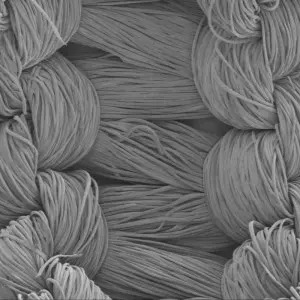
PolyPure-braid uses multiple intertwined yarns to create a tubular shape on which a membrane layer can be applied. The crossing yarn arrangement gives the engineer a specific textile architecture to examine instead of treating all white tubular supports as identical.
PolyPure-knit uses interconnected yarn spirals, with density governed by the spiral pitch. Here the connected loops and pitch form the relevant construction description. When comparing candidates, record the construction alongside the diameter so that a later trial refers to the same textile structure.
| Selection variable | Braided candidate | Knitted candidate |
|---|---|---|
| Yarn arrangement | Intertwined yarns forming a tube | Interconnected yarn spirals |
| Construction detail to retain | Braid structure and mesh selection | Loop structure, spiral pitch and mesh selection |
| Shared development question | Does the tube geometry suit the membrane process? | Does the tube geometry suit the membrane process? |
Use these differences to define candidates, rather than ranking one architecture as universally better. The useful choice depends on how the actual tube behaves in the buyer’s membrane-development process.
Keep the lumen and outer surface consistent
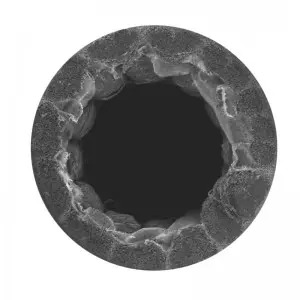
The hollow passage and outer textile surface serve different geometric roles. The lumen defines the internal passage; the outer surface receives the membrane layer. Inspecting both helps prevent an acceptable outside diameter from hiding an unsuitable cross-section or irregular surface.
Look for changes along the sample as well as at a single end. An oval section or a projecting filament can affect how the coating forms around the support. The development team should define acceptable geometry and surface condition for its own process, then compare candidates against that same requirement.
Cross-section and surface images are useful for recognising these two inspection views. They are not dimensional measurements unless a calibrated method and scale are provided. Record measured inner and outer dimensions with the measurement condition, rather than estimating them from a photograph.
Choose mesh density with the dope solution
PolyPure offers different mesh densities for selection with the dope solution. That makes the wall structure part of the coating discussion: a mesh chosen independently from the dope may leave the developer comparing two changed variables without knowing which caused the difference.
Describe the dope system and the desired support/coating interaction when discussing a candidate. Review the textile wall, surface and process behaviour together. An open-looking mesh alone does not predict the finished membrane’s flux, retention or service performance.
Compare candidates in a controlled development trial
Select a small comparison that answers one construction question. Retain candidate identity, tube geometry, braid or knit construction and the process settings used. When possible, keep other development variables unchanged while comparing the support; explain any unavoidable change in the trial record.
Inspect the resulting membrane geometry and evaluate it under the buyer’s normal development and acceptance procedures. If the standard candidate does not match the required geometry or coating process, discuss a customised support configuration with the target inner/outer dimensions, dope system and observed mismatch.
FAQ
Is the PolyPure support tube itself a finished filtration membrane?
No. It is a textile reinforcement support used in membrane development. The coating system and final membrane evaluation remain part of the membrane manufacturer’s process.
How do PolyPure braid and knit differ?
Braid uses intertwined yarns to form the tube. Knit uses interconnected yarn spirals, with density governed by spiral pitch. Compare the actual candidate structures with the required geometry and dope system.
Does the 1.0–10 mm range define my final membrane dimensions?
No. It describes the support family’s diameter offering. Specify the requested support geometry and separately evaluate the coated membrane produced by your process.
Discuss a PolyPure Support Configuration
Review the PolyPure tubular support family, then share the target inner/outer geometry, braid or knit preference, dope system, mesh needs and process-trial conditions. Discuss a PolyPure support configuration with Bonsing to define a candidate or explore a customised option for evaluation.
Post time: Oct-28-2026