
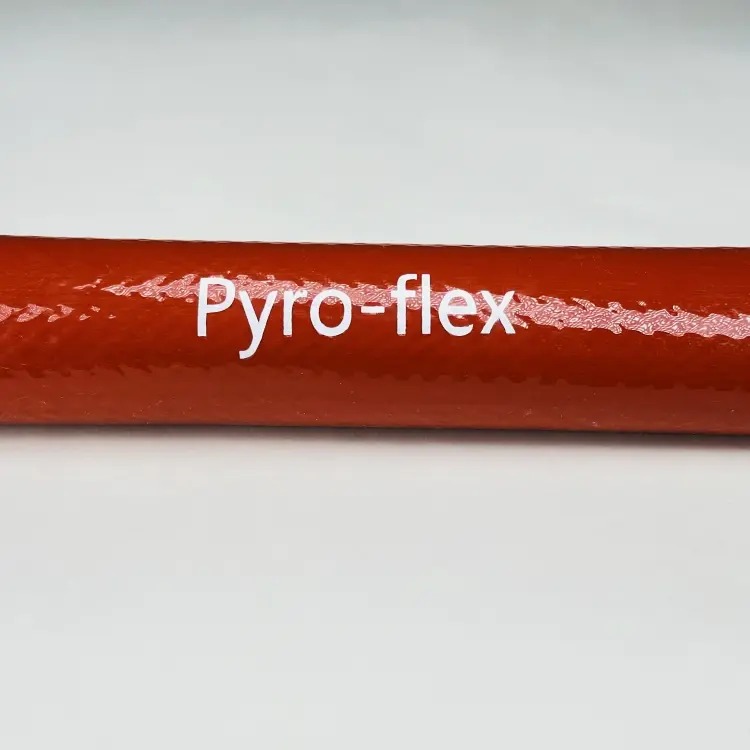
Pyroflex silicone-coated fiberglass firesleeve is a thick-walled woven glass-fiber sleeve coated with flame-retardant silicone rubber. For a hose assembly line, the length request should describe the section that needs this surrounding thermal covering, rather than assume that every hose uses the same sleeve length.
Pyroflex firesleeve has a stated continuous high-temperature resistance of 260°C. Choose the thermal covering for the intended exposure and then translate each covered segment into a production length and quantity. A temperature figure and a cut length answer different questions.
Start with the protected segment
A hose assembly can have a total end-to-end length that differs from the part exposed to heat. Mark the intended sleeve start and end on the drawing or on a representative assembly. Measure between those points using a defined method, including whether the measurement follows the hose path or another agreed reference. Keep that convention beside the dimension.
Pyroflex firesleeve is installed on cables and hoses and can expand over fittings or joints. The sleeve is the surrounding covering; the buyer’s hose, end fittings and layout define where that covering needs to sit. Record the intended coverage positions so the assembly team can relate a requested length to the physical part.
Build a variant-to-length schedule
For a repeat order, list each hose part number or drawing revision, its covered segment, requested sleeve length and quantity. If two hose variants share a length, keep the part references visible instead of assuming they remain identical after a design change.
| Production input | Why it belongs in the request |
|---|---|
| Hose variant and drawing revision | Connects the length to the correct assembly |
| Start and end of intended coverage | Shows where the sleeve is meant to sit |
| Length and measurement convention | Reduces ambiguity when the part is prepared |
| Quantity by variant | Helps the buyer and supplier align the order |
| Marking or packaging needs | Supports the buyer’s production handoff when relevant |
These are planning fields, not a cutting formula. Discuss any allowance or end treatment for the actual sleeve and assembly; the drawing alone should not be interpreted as a universal allowance.
Keep thermal duty with the production record
The cut-length schedule tells the production team how much covering to place. It does not describe the heat source, exposure duration or the duty of the line inside. Keep the intended application and heat exposure alongside the schedule so a change in equipment duty is not hidden by an unchanged part length.
The sleeve surrounds the buyer’s hose or cable. Check the actual geometry and placement on a representative assembly before releasing a repeated production instruction. If the coverage positions or production format change, bring the revised drawing and quantity to a customised-configuration discussion.
Trial the handoff before repeating the order
Select representative variants and compare the prepared sleeve with their marked coverage positions. Have the production team confirm that the length convention is understood, then retain the approved drawing revision and order reference in its own records. Record any mismatch by part and location so the next discussion concerns a measurable change rather than an estimated adjustment.
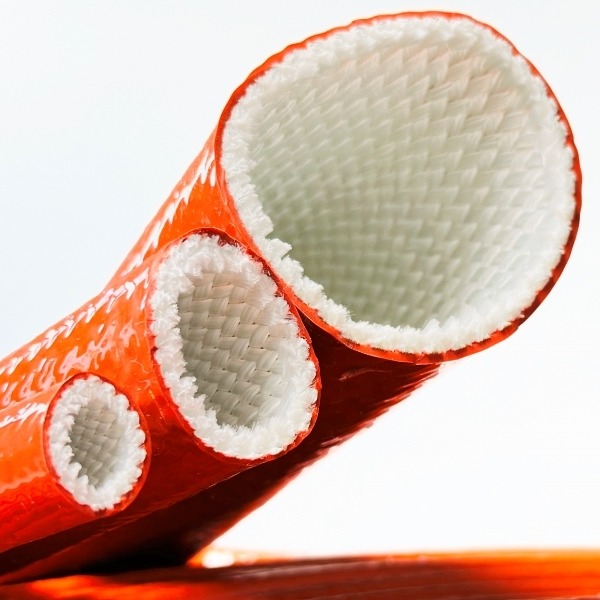
Inspect the prepared cut ends as part of that handoff: the coated exterior and woven interior are visible at the end of the sleeve. Record any handling or end-condition requirement with the length request instead of assuming a universal finish.
FAQ
Is sleeve cut length always the hose’s overall length?
No. Specify the intended covered segment and the measurement convention for each assembly. Overall length is useful context but may include areas outside that segment.
Does the 260°C sleeve figure determine the cut length?
No. It describes the mapped sleeve’s stated continuous high-temperature resistance. Length is a separate production and coverage decision.
Can different hose variants be included in one request?
Yes. Provide each variant’s drawing reference, intended coverage, requested length and quantity so the configurations can be discussed clearly.
Request a Cut-Length Review
Review the Pyroflex firesleeve. Share the hose variants, coverage start and end, length convention, quantities and exposure. Request a cut-length review or discuss a customised production arrangement with Bonsing.
Post time: Nov-10-2026