
SPANDOFLEX is an expandable and abrasion-protection sleeve family for wire and cable harnesses. Its braided construction provides a surrounding mechanical covering while retaining a visible weave. Surface coverage helps a harness engineer describe how much of the underlying surface is covered by the braid, then compare candidate constructions on the actual bundle.
The family offers surface coverage of 75% for standard applications and options up to 95%. Use those figures to open a configuration discussion: the selected model, installed bundle and acceptance method still matter when comparing candidates.
What coverage tells a harness engineer
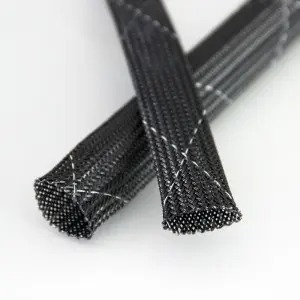
A braid contains intersecting strands and spaces between them. A more open or more covered appearance changes what is visible through the sleeve and helps the engineer define a preferred covering for a contact area. Coverage is a construction measure; it is not a percentage of abrasion resistance or a guarantee of how long a harness will last.
Start with the location where the harness needs a covering. Identify the contact surface, any movement and the length of the exposed route. Then decide what the production team needs to see or access once the sleeve is in place. These observations make the requested coverage more useful than a percentage selected without the assembly.
Compare the family options in context
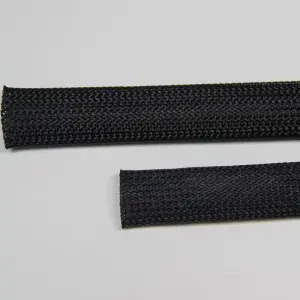
The 75% standard application figure and options up to 95% belong to the SPANDOFLEX family. They provide a starting range for discussing candidates, not a specification shared by every model. Ask which construction corresponds to the desired coverage and how it is defined for the proposed configuration.
| Buyer question | What to compare |
|---|---|
| How much underlying surface should remain visible? | The actual candidate braid on the representative bundle |
| Where is contact expected? | The covered area, contact surface and movement |
| How will the sleeve be installed? | Bundle dimensions, connectors and access |
| What confirms suitability? | The buyer’s assembly-specific acceptance method |
Fit the candidate to the harness
Braided SPANDOFLEX sleeves expand to fit bulky connectors and are installed on components. Expansion helps the team consider how a surrounding sleeve reaches its position on a harness; the real connector envelope and installation route still need review. Look at the braid in its installed state on the representative bundle rather than judging only an uninstalled sample.
The harness and its connectors are supplied by the buyer. The protective sleeve is the covering placed around that assembly. If the desired coverage, access or contact conditions differ from the candidate construction, discuss a customised configuration with the bundle dimensions and the intended contact zone.
Set an acceptance question before the trial
Record the candidate’s identity, bundle size, installed position and the criterion used to compare it. If contact wear is the concern, evaluate the complete assembly under the buyer’s relevant procedure; the nominal coverage figure alone cannot predict the result. Keep the same comparison method across candidates so the outcome is tied to the decision being made.
FAQ
Does 95% coverage mean 95% abrasion protection?
No. Coverage describes a braid construction measure. Abrasion performance depends on the selected sleeve and the actual contact conditions and should be assessed for the assembly.
Does every SPANDOFLEX model have the same coverage?
No. The family offers 75% for standard applications and options up to 95%; identify the coverage and construction of the proposed model.
Is a braided sleeve a sealed barrier?
A braid has spaces between its strands. Select and evaluate the complete assembly according to the required covering and environmental conditions.
Discuss a Coverage Requirement
Review the SPANDOFLEX protective sleeve family. Share the bundle dimensions, contact zone, required coverage, connector layout and acceptance method. Discuss a coverage requirement with Bonsing, including a customised configuration when needed.
Post time: Nov-11-2026